The Assets That Are Never For Sale
The first Tokenezo letter. July 2026.
This letter is about property you will never see advertised.
Start with a small experiment. Pick the best building in your city. Not the prettiest — the best: the one that is never empty. The corner house in the old town with a queue of tenants. The office building that has not had a vacancy in nine years. The pharmacy that has been a pharmacy for eighty years.
Now try to buy it.
You will not get far, and price is not the reason. Buildings like these are not real estate in the ordinary sense. They are machines that turn location into rent, month after month, in almost any weather. And people do not sell machines that print money. Unless something happens to them.
One uncomfortable conclusion follows, and we invite you to test it against your own city: everything you can see on the portals during a boom is, by definition, what smart owners agreed to let go. The public market is the shop window of the second-best. The best shelf exists — it is simply never shown.
That sounds like a slogan until you look at the mechanics. So let us look at the mechanics.
How money actually reaches the best buildings
Ask why the owner of a prime building would never put it on a portal, and the answers stack up fast.
A public listing is information, and information moves against the seller. It tells the tenants that the ground under their lease is shifting — some start renegotiating, some start looking at doors. It tells lenders and competitors that somewhere in the owner’s affairs, cash is needed. And it burns the asset itself: a building that visibly failed to sell at a price wears that price like a scar for years. For a working money printer, a listing is not marketing. It is a confession.
Then there is the arithmetic of the buyer pool. For an ordinary flat there are thousands of buyers, so you advertise. For a prime old-town corner building, the buyers who can pay, decide fast and close quietly are a few dozen names in the whole region — and the seller’s banker already knows most of them by heart. Why would anyone print a poster for thirty people whose telephone numbers they have?
So the trade moves the way serious, discreet trades have always moved: a banker calls a lawyer, a family office lets it be known it is looking, an agent works with a mandate rather than a listing, and price is discovered across a lunch table instead of a bidding portal. A place on that call list is earned, and the criteria are boring and brutal: money that is demonstrably there, a record of closing at the agreed number, and a reputation for never renegotiating in the final week. Cash, speed, discretion, trust. Nothing else impresses anyone.
There are exceptions — moments when the best shelf is dragged into daylight. An insolvency administrator has a legal duty to advertise. An estate at war with itself ends up in court. A pledge gets enforced. These are the good assets that did not get carried out in time — and they are rarer than you would think, because smart owners start thinking ahead of time: they restructure, refinance or sell quietly long before an administrator reaches the door.
Which gives the rule its final, cruel form: when you see a truly prime building in a public listing, either it is not truly prime, or something upstream has already gone badly wrong.
Almost never, then, does the best shelf open. And “almost” has very specific dates in history.
A story we cannot verify
Munich, after 2008.
German property prices did not crash then — the transactions did. Money spent on real estate fell by tens of billions in a single year; commercial deals shrank by some eighty per cent in two. The market did not go down so much as it went silent. And in a silent market a strange species becomes visible: the buyer with cash. The whole game reduces to two questions — who still has money, and who has assets worth taking.
The story reaches us second-hand, and we tell it as it was told; the dialogue cannot be verified, so treat it as a parable. The numbers around it can be, and we will get to them.
Locals are driving a friend from abroad around the city — the friend has cash and is deciding what to do with it. People like that think in a particular order: liquidity first — how fast could this be sold again, and to whom — then supply, then demand, and only then the photograph. And people like that find downturns quietly comic, because whole categories of expensive things turn out to be, so to speak, shakeable-off: the discretionary layer that a strong economy had priced like oxygen. On the periphery there is suddenly so much to see — handsome country houses with big workshops attached, commercial plots, even an asphalted car-dealership yard with its flags still flying. The luxury of it, the sheer volume of it, the speed of the discount on it. Go and buy — point a finger through the car window and buy.
The buyer shakes her head. Stop showing me these, she says. Show me the city centre. Show me old-town shops to grab.
The agent answers:
“Madam, when you can grab deals in the old town that easily — Munich will be dead.”
We said the dialogue is unverifiable. Here is what is not. Germany’s franchise car dealers really were dying off by the thousands — around eighteen thousand at the millennium, eight thousand by 2010. The Bundesbank later measured what that agent knew by instinct: in the years after the crash, house prices in the median German district grew by exactly zero per year, while apartments in the seven big cities rose by a quarter. And when the world’s frightened money then discovered German bricks, the Germans coined a word for it — Betongold. Concrete gold.
The moral of the story is not price. It is access. The distressed periphery was available to anyone with cash. The core was available only to whoever’s telephone rang. In a reorganisation of wealth, the discretionary layer bleeds first and loudest; the core changes hands rarely, quietly and last. And if an old town ever does turn up in an open sale — that is not an opportunity. That is an obituary.
What “buy the dip” was supposed to mean
The phrase is older than the internet — brokers were telling clients to buy on the dips generations before anyone typed it in capital letters. But it became a mass reflex only recently. After 2009, every serious dip for a decade and a half was bought back — first by central banks, then by everyone who had watched the central banks do it. And in the AI-mania years the words finally wore smooth, like a coin that has passed through too many hands: a generation now applies them to everything, which is another way of saying they mean nothing.
Here is what the phrase was supposed to mean. A dip is only a discount if the asset must still exist on the other side of it. In a fashion, a dip is not a dip — it is simply the beginning of the fall. But in an asset that is always expensive, always needed, always survives — the building from the first page of this letter, the one that is never empty — a real correction is the event patient money measures its whole decade by. That is the true buy-the-dip, and it comes perhaps twice in a working lifetime.
And the best assets add one final twist: they rarely dip in public at all. Their dip happens by telephone. Which is why the discipline is not scanning portals for bargains. The discipline is becoming the kind of buyer the telephone reaches.
Hold that thought. The whole platform stands on it.
2009, briefly
We had our own reorganisation, at home, and its chronicle fits in a paragraph.
Our home market is Lithuania — the Baltic corner of the EU, which ran the eurozone’s most instructive boom-and-bust. An economy that had roughly tripled its property prices in four years, on bank credit growing forty per cent a year with no loan-to-value cap in the rulebook, contracted 14.8 per cent in a single year. Flats on the coast fell more than forty per cent from their peak; the older stock halved. Rents fell by a third. Unemployment rose toward eighteen per cent, and the state, refusing to devalue, borrowed on the markets at 9.75 per cent.
People remember it as the year money disappeared. But money did not disappear — money moved from one position to another. While the airport departure boards filled with one-way flights, the first line at the sea kept quietly acquiring new owners: one coastal agency later told a local paper that its revenues never flinched through 2010, 2011, 2012 — buyers from the east, premium seaside flats, no financing, no headlines. Money like that would not clear a compliance desk today, and it is good that it would not. The lesson survives its buyers: in the bust, the beach was for sale — and almost nobody local was in a position to answer the telephone.
Assets that would not have been sold at any price in 2007 had new owners by 2010. From a valuer’s chair, that is what a crisis is. Not an ending — a transfer of ownership.
The present, in numbers
What follows is mostly numbers. The conclusions are yours to draw — we give ours afterwards, but the numbers belong to everyone. We write assuming the reader is smart; it is the only audience worth having.
Between 2020 and 2022, the central banks of the United States and Europe added roughly nine trillion dollars to their balance sheets, and governments spent trillions more in fiscal support. The S&P 500 fell 34 per cent in twenty-three trading days — a fall that had taken seventeen months in 2008 — and was setting records again within six months, the shortest bear market ever recorded. The index needed seventeen months to climb from 6,000 to 7,000; this spring it needed seven weeks to climb from 7,000 to 7,600. The ladder itself is the froth.
Dotted points are documented closes, each sourced in the data layer; the curve between them runs through month-end closes and is interpolation, not a daily series. Dashboard readings as of June 2026.
Table view — the documented closes
| Date | Close | What it marks |
|---|---|---|
| 19 Feb 2020 | 3,386.15 | Pre-pandemic record close |
| 23 Mar 2020 | 2,237.40 | Trough: −33.9% in 23 trading days |
| 18 Aug 2020 | 3,389.78 | New record — shortest bear market ever recorded |
| 3 Jan 2022 | 4,796.56 | 2022 peak close |
| 12 Oct 2022 | 3,577.03 | 2022 trough: −25.4%, bought back |
| 9 Feb 2024 | 5,026.61 | First close above 5,000 |
| 11 Nov 2024 | 6,001.35 | First close above 6,000 |
| 15 Apr 2026 | 7,000 | First close above 7,000 — seventeen months after 6,000 |
| 2 Jun 2026 | 7,609.78 | Record close — seven weeks after 7,000 |
| 13 Jul 2026 | 7,515 | Close as the letter went out |
In Europe, the flood behaved the same at every scale. Support money settled in company accounts — in our home market, bank deposits jumped thirty per cent in 2020 alone — sat there nervously for a while, and then went looking for assets. In the fever year of 2021, two-thirds of all housing purchases in our country were made without a mortgage — by count; by money, half. Cash, chasing. Then inflation arrived to present the bill: over ten per cent at the euro-area peak, above twenty in our corner of it.
Across the EU since 2015, house prices have risen about 65 per cent on average while rents rose about 22 — and at the extreme end of that table, in our home market, prices rose 168 per cent and are re-accelerating as we write. When prices triple while rents crawl, yields compress until the investment case must lean on one assumption: that growth continues. On our own Baltic coast, builders now bolt a small pool onto every new block — not a pool to swim in, a pool to photograph — and seaside flats with a three-month season have been asking what year-round Mediterranean resorts ask. We will not argue with any single price here; prices move faster than letters. The season does not. Rental return needs occupancy, occupancy needs a season, and a season of eight warm weekends has to pay for a very Mediterranean price.
Rearmament belongs in this ledger too, honestly handled: war spending lands in GDP as stimulus, and the ledger does not ask why. Europe added something like $139 billion of defence spending in a single year — the sharpest rise since the Cold War — and, knowing why, we will not spend a word complaining. But the European Commission’s own arithmetic says an extra one and a half per cent of GDP in defence buys about half a per cent of extra GDP by 2028, and most of the famous €800 billion is borrowing permission, not fresh money. Tanks do not build houses; they flatter the line while they last. On the other side of the front, a state now sends roughly two-fifths of its budget to the war and taxes its own people harder to keep the furnace fed — growth bought this way ran at four per cent until last year, when the sugar ran out and it grew one.
And the honest concession, because a bear who hides the bull case is a marketer, not a valuer: much of Europe’s periphery genuinely converged. In our home market, net wages nearly tripled over the decade and GDP per head reached 87 per cent of the EU average. Part of the price growth is not a bubble at all — it is a nation actually catching up. In one decade, a broad, propertied, confident middle class formed where none had existed in living memory.
It formed entirely inside a rising market. It has never taken a punch.
Our position — and where we may be wrong
Tokenezo’s view of the world economy’s present health is sceptical, and we say so openly, because hiding a position would be a dishonest foundation for a trust business: to us, today’s altitude looks like the late setup phase of another reorganisation.
But there are no prophets here, so immediately — the two scenarios in which we are wrong.
First: artificial intelligence. If the models keep getting better and cheaper, and productivity finally outruns the debt, then the valuations of 2026 were not a fever — they were the market correctly pricing the biggest input-cost collapse in economic history, and what looked like fatal altitude was base camp. We weigh this scenario seriously: for the first time in our lives, the bull case requires no magic — only engineers.
The second is more uncomfortable, because it beats us with our own numbers: the correction comes — and nobody has to sell. There are no margin calls on a flat bought with cash. Prices sag, volumes die, owners sit, and the telephone stays silent. We have one and a half answers. Developers and commercial owners do carry leverage — construction loans do not care how the buyers paid. And time forces transactions that prices cannot: estates, divorces, partnerships ending, funds reaching the last page of their charter. But we hold the scenario openly: it is possible to be right about the top and never be handed the bottom.
And one more piece of honesty. Pessimists have been wrong for a while now — looking back, maybe too long. HA. The bulls are riding the longest expansion in modern history, and we respect it without irony; twice in that run the bears were briefly right, and both times the flood bought the dip back within months. The difference now is that the excess savings which did that buying were depleted by 2024, and the printer has an inflation bill stapled to it. Still — the difference between us and most property-tokenisation offers today is not opinion but the bet: at today’s prices, rental yield no longer carries the case, so the case must lean on the assumption that growth continues. We refuse to lean on it. We do not need the bulls to be wrong — we simply do not need them to be right for another decade. Value, as we understand it, is created by buying well, not by hoping the market lifts you.
So we are not buying. We are preparing.
Three arenas
Tokenezo is built as a table that seats both sides of the bet — with a workshop next door.
The Bulls’ arena. Seriously, without mockery: half our readers believe in the continuation, and they hold the longest winning streak in history. In time there will be offers for them — more on that later. One rule will bind everything we ever publish: next to every offer, our own bear case, printed on the same page. Adults, same numbers, opposite conclusions.
The Bears’ arena. Patience, dry powder, and watching for the best shelf to open. The logic of this letter lives here.
Learning by doing. The third space is not an arena but a workshop. Small, real ventures; mistakes are data; losses are tuition, paid in small money. Here the community grows in every sense: members gain knowledge, projects gain hands, and dreamers sort themselves from doers. If you have a free evening, read about “Universe 25” — the experiment in which mice were given everything and lost their hunger. Scientists still argue about what it proved. We will say only this: in markets, hunger is a load-bearing structure, and the workshop exists so that we do not lose ours.
What no arena will have is a guru.
The little house
Grand theses are cheap on the internet. So the first Tokenezo object is deliberately small.
In the far south of Lithuania, seven kilometres from the Polish border, lies a town of four thousand people called Lazdijai — lake country, pine forests, storks. In its exact centre, on an open lawn next to the town gymnasium — the one with a giant moose painted on its gable — stands a one-storey log house under faded sea-green boards, built in 1936, lace curtains still in the windows. The state’s own registry values it at about thirteen and a half thousand euros. It is worth little money and a great deal of attention.
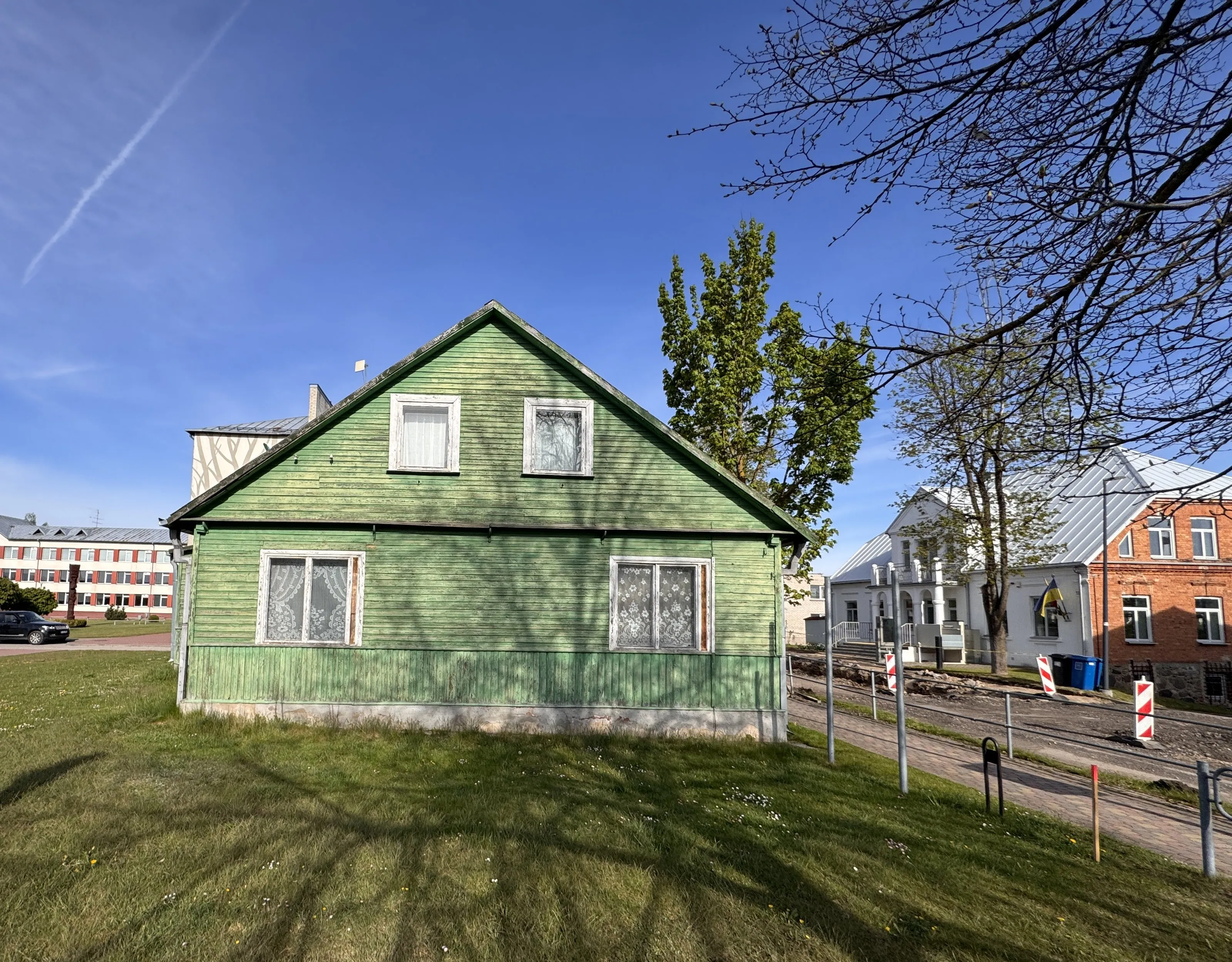
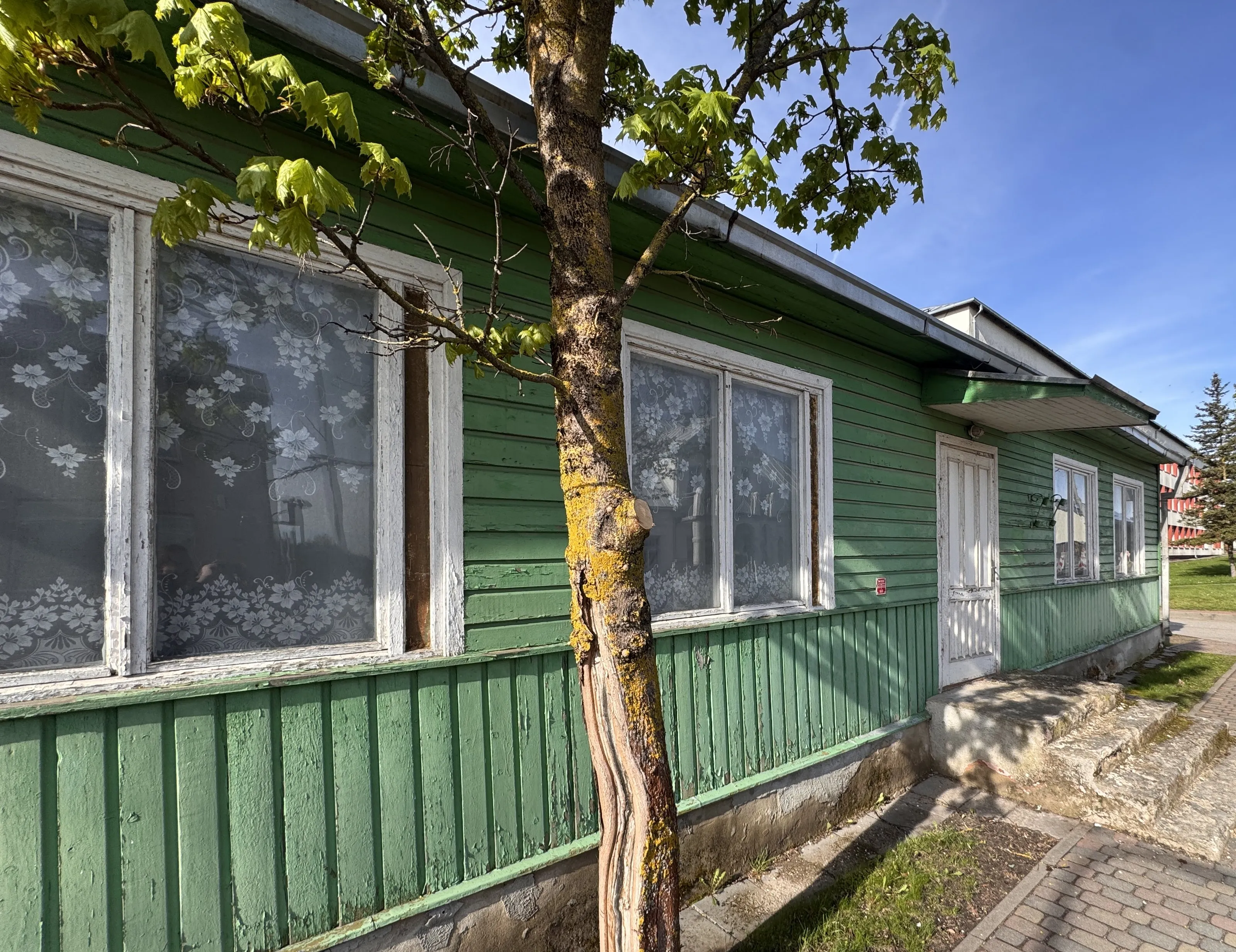
The house on Vytauto street: log walls under sea-green boards, 1936 — lace curtains still in the windows.
Tokenezo is handing this house to its community — the legal wrapper will be published before the first community euro moves. It is the first Learning-by-doing project, and its win condition was chosen with care, because it is deliberately, almost insultingly small:
Renovate the house, open something in it — and legally sell one coffee to a teacher from the gymnasium next door. Or one candy to their pupil.
That is all. Because consider what one legal transaction demands from a community that has never met: agree on a plan, vote on it, put money behind it, become the hands or hire them, pass the permits, open a till, and account for the euro that lands in it. Governance, capital, labour, law, trust — every link of the chain, tested end to end, where failure costs a roof and a little pride, not anyone’s savings. If the coffee gets sold, the chain works. And the community is real — not a chat channel full of strangers with opinions, but people who have fixed a roof together.
Trust is the scarcest asset in this business, and it cannot be bought with an advertising budget. It is built slowly, by doing something small, real and slightly absurd together. We take this test first, in public.
Then — and only then — the real assets.
The invitation
What Tokenezo is today, without decoration: a position, a house, and an open door. The rails we will run on are regulated — tokenised real estate in Europe is a transferable security, and that is good: the rules protect people, not platforms. Partnerships and the fee schedule will be published when there is something to publish, on the same page as the offers, because the one number a trust business must never hide is its own price.
The waitlist is open at tokenezo.com. Members get the forum first, and the first vote on the Lazdijai house belongs to them. Choose your arena — bulls, bears, or the workshop with a hammer. And bring your own numbers: we will check each other’s.
After a fire, the grass comes back first. We do not hope for the fire.
We just know how forests work.
Every number in this letter is either sourced in the data layer published alongside it, or flagged in the text as market memory. Check us — that is the culture we are building. And formally: this is opinion and analysis, not investment advice and not an offer of securities.